


Summon the Keeper: The Keeper's Chronicles #1
 I've been a fan of Tanya Huff's book since my high school days, but I started with her Fantasy series first, ( Fifth Quarter et al, Wizard of the Grove, Of Darkness, Light, and Fire ). You see some of her snarky humour in those stories, but nothing in them prepared me for the smiles and laughs I got out of Summon the Keeper. Huff always has amazingly real characters and she can have them fighting racist talking lizard people without missing a beat. Every character has their comedic moments and none are done in the same way. Being from Canada I might have gotten some extra mileage out of a few of her jokes =]. The story is in no hurry to get anywhere and that's more than fine because Huff sets out to entertain you every single page. The fantasy world has time to explain itself and many creatures make their way to "Elysian Fields Inn" which is especially fun for those of us who know their mythology. I feel I should mention that the blurb might promise more romance than really appears...I'm not sure if I'm spoiling anything by saying that there's more romantic tension than an actual love story. These days, I find we tend to expect a particular level of romance in our urban fantasy, but this is an older book (published in 1998), so it's fun to see what was going on in the urban fantasy genre when it was kind of in its "teenage" years, before it had the glut of established tropes that it has now.
 If you want some light, endearing and incredibly entertaining reading then I highly suggest reading the entire trilogy, though Summon the Keeper is the best of the three (this review is actually the result of my third re-read).
Practical Magic
 Having never known that the movie was based on a book I could hardly break my "no movie till the book has been read" oath following the Lord of the Rings tragedy. But here I think I hardly have worried, because I have found that rare thing, a story that is better on the screen than the page (in my opinion). The spirit of the characters is all the same, except for Sally's two daughters; in the book, we follow the younger sisters up to their teens and they are much more fleshed out literally and figuratively. Most of the book centers on the interpersonal relationships of the two sets of sisters and their love lives. There's so much introspection and emotional characterization that I didn't feel like I was reading a good story so much as a parable in the form of a therapy session. Getting rid of Jimmy Angelou takes no more than 3 pages at most at the very end of the book. I don't even think "magic" or "witch" is used more than twice each. There is a "magic" of a sort in the book, but its a more inherent kind, rather than using potions or spells, but the women have no real control over the way they affect their surroundings, their mere presence sets off all kinds of havoc. The movie was more gripping and less touching, but at least it doesn't leave you exhausted and haggard afterwards. The main difference is big and it's this: the movie tells you that sisterhood conquers all attackers. The book tells you that your worst enemies are yourself and your "sister" and no one else can protect or sabotage you better than they.
Arabella
 While this is not the first of Heyer's novels that I've read, it was the one I was most interested in reading, because it seemed to promise the most repartee, and while it did deliver, most of it was between the lead male, Beaumaris, and the stray dog he picks up. While Arabella has her passion and purity, she sadly lacks the wit I was expecting. I really hate to think that all Heyer leads will be the mice in their feline husbands games. This may be precipitate since this is only my second Heyer novel (the first having been The Convenient Marriage), but I'm suspecting a Heyer "template": Rich bored aristocrat goes all out to win the "enchanting" and impudent female and wins her over by aiding the pockets and reputations of her brother and family. I nearly called Beaumaris "Rule" and Bertram "Pelham". They had not the same character but fit the same mold. While I loved Rule for his irreverence, I think I enjoyed Beaumaris better since he is more the cynic and less the rake. And I have to say that I really dislike how Heyer describes the women, her relations and her toillettes so well and with so much detail but almost entirely neglects the hero's description. I know its supposed to be vague to allow your imagination to run but there's something wrong when I can envision a smart blue coat with lapels and pantaloons, but no real body inhabiting it nor face and head seated above it.
Lady Thief
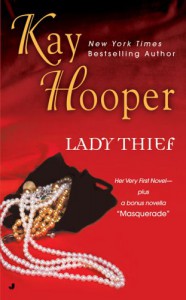 This is the author's first book and it shows. There were many times where I had to roll my eyes, by I always did so with a smile, too. There's alot of cliche moments, especially concerning the dialogue, and her descriptions of love. Rather than feeling the couples were in love I was immediately told they were. It was rather anticlimactic how quickly everyone paired up. It lacked the subtlety and craft that I KNOW Hooper does well in her later works. Despite this I was able to enjoy the story, because Hooper manages to sell it convincingly, if not expertly. Also, another reason I might have enjoyed this more than I should have was the constant echoes of Georgette Heyer. The plot points resemble many of Heyer's, and even the names were very familiar (Ware, Standen). I had fun playing a kind of "Where's Waldo?" with all the Heyer references. The Regency staples were there, but the story does take quite a few liberties in terms of historical attitudes. While the characters may not have been incredibly unique or completely fleshed out, they were endearing all in their own ways. The mystery too, is somewhat simplistic, and somethings are a bit unanswered, (ie the purpose of the missing ring) but, those can be forgiven if what you're really after is a light short sweet read.
 Edit: read the short story "Masquerade" at later date
I had to give the novel another star because I liked this short story so much better than the novel it accompanies. It's another Regency, this time with a misunderstood rogue and an independent minded woman stuck together by random circumstance (the weather). It is both a sweet and intense romance that plays out predictably but enjoyably. I'm not crazy about HEA's but Masquerade does it just right. This is no insult to the romance in the book, but my favorite part of the story is the politics of the servants and the minutiae of manor life. I really like those kind of details in my historical fiction. This book is worth buying for the short story alone, imo.
Blood of the Wicked: A Dark Mission Novel

I'm not sure how to go about rating this one.
I enjoyed it quite a bit, but the story itself had some problems that required a lot of complicity from me as a reader to be so ready to suspend my disbelief. I loved her prequel novella hoping that the small problems in there would be addressed in the novel. Unfortunately this is not the case. Same problems, just on a bigger scale.
The world building is fractured at best and there's only a very nebulous connection between witches and the post-apocalyptic world. There's no explanation about why Witches were singled out to shoulder the blame for the Cataclysm. Yes, PNR and UF often just drop magical folk on you, but the good ones tell you how they came to be and how they interact with the world and how the world interacts with them. Cooper sets up this post-apocalyptia and we must take it in faith that it all works. And it does, if you accept the premise wholeheartedly. So for the sake of enjoying the story, I did.
What I loved about the novella I love in this book too. Cooper has very immersive writing, which helped me forget some greater plot holes, because she is amazing at setting up the bleak tone and mood of the distopic world and managed her characters so well. We spend allot of time in Jessie and Silas's heads, we get to know them inside and out. Her writing is also very intense, lots of anger, lots of grief, lots of tension filled sex. Though, I will say that I was weirded out by the quick pacing and backwardness of the romance. Couples can get together faster under unique/stressful circumstances in a short story. Not so a novel. They timidly get to know each other later in the novel, after they spend the first six or so chapters lusting after each other. I had noticed this about her novella as well. Cooper doesn't make you wait 3/4 of the way to give you the sex. She gratifies you first then gives you the slow building love after. I'm generally used to this being the other way around. The sex scenes themselves are eloquently graphic, intense and brief. I have to admit, however that I'm not an expert on PNR and tend to read more on the UF side of the spectrum, so maybe this backwardness is typical?
The distopian world is interesting, but we're not told enough about it, and even while Silas and Jessie's intense romance is the Main Point I was often distracted by the fractured world/setting they were in. After a good romance I like to linger on the finer moments of the lovers tale, but at the end of Blood of the Wicked I found myself pondering all these questions I had set aside to enjoy the love story.
Some of these questions are spoilers, so if you're very curious:
So, I really enjoyed it, I'd have given it a 4.5 easily, but these niggling problems force me to drop it to at least 3. I will keep reading the series and hopefully these world building problems will improve.
Before the Witches (Dark Mission 0.5)
 This novella is a short prequel to Her Dark Mission novels, but you don't have to read it to know what's going on in the first book of the series. It takes place during the apocalyptic event that is mentioned in the books, so really it's a front row seat to the destruction. I read the e-book version, as I don't know if there is a print version available.
Now, I'm having trouble rating AND reviewing this story because...well, I loved it, but I have to admit that it isn't perfect. So in the interest of fairness I'll pull the old Good vs Bad style of review.
The Good Stuff:
This is an unbelievably intense short story. It made me ghasp, tear up, blush, and filled me both with dread and hope. It is an incredibly engrossing and very rewarding short read. The pace was fast and the drama is the kind of heart-wrenching thing that makes you cover your mouth and shake your head as you keep turning the pages to find out what happens next. There's only 150 or so pages to meet some 10-12 characters and each one feels real and believable in the very short time you know them.
The Bad Stuff:
Despite that I enjoyed myself immensely, there were things that confused me. For one, the action. While intense, it isn't always comprehensible and I wasn't always sure what was happening. The larger problem is that "Witches" and any actual witchcraft have very little to do with the story. So if you are expecting some supernatural elements, you will only find the barest hint of it. You could take the whole witch thing out and still have and incredibly good story. As a matter of fact, it might make more sense if there were never any mention of witches at all.
So the long and short is that Karina Cooper is excellent at three things: Mood, Emotion and Characters. Her world building however, needs a lot of work. Luckily, this doesn't make the story any less enjoyable. If Karina's novel addresses the problems in the short story she might just have converted me into a PNR fan. I've been more on the Urban Fantasy bench until now.
Bet Me
 Eh, I didn't like it as much as Welcome to Temptation. It wasn't very memorable except for the fact that there was a freaky over-fetishization of food. I didn't find it all that entertaining, and if it wasn't for the very long car ride I was on, I might not even have bothered to finish it. I'll pick up another Crusie, but this one just didn't do anything for me.
Welcome to Temptation
 I like quick and dirty reads, and that's exactly what this was. Not only was it amazingly entertaining, it was hilarious and even a little whimsical. It had some fantastic love scenes and even though everything ended as neat as a bow, that's exactly what you want at the end of a book like this. There's nothing especially profound or philosophical, but but you will get a decent appreciation of small town life and how deranged it could be.
Soulless: The Manga, Vol. 1 (The Parasol Protectorate (Manga))
 I loved, loved, loved the Soulless novel and I was unbelievably excited about the manga. They finally got them in our local bookstores and read it on the commute home.
The Good Stuff:
I liked the round and organic feel of the art, it didn't have that overly sharp and angular art that I'm not too fond of in a lot of manga.The backgrounds were gorgeous, and it was lovely to see little steampunk touches here-and-there, like bizarre bikes in the the park, dirigibles randomly in the sky, The Vampire Hive background detail was amazing, the glassicals (which were a little underemphasized imo). I can only imagine how fun it must have been to come up with the clothing designs. There are some pretty intimate scenes in the novel, and they were translated quite tastefully- it added to the humour to see the artist's efforts to cover up Lord Maccon's private bits towards the end. The Vixi Man was appropriately gruesome, more so than I had imagined him even, and the villains were quite creepily rendered. And then there's Lord Akeldama! not as I imagined him, but I still loved him anyway: I only wish he was in colour so that we could get the full effect of his...particular fashion sense. It was nice to see a fully realized world of Soulless, and as a fan of the series, I really enjoyed it.
The Not-so Good Stuff:
I was a little disappointed in how short it was. I didn't think the entire novel would fit into a single manga volume, and I wish it had been at the very least, two volumes. It does have this rushed feel to it, and I think that if you are not already familiar with the series, some parts of the world and the plot points of the story can be confusing. Also, if it had been split, there might have been more time to focus on things that I felt were grievously underemphasized, like the aforementioned glassicals, the marvellous butler Floote, Tunstell was only in 1 or 2 two panels, and Ivy's hats! They were far more underwhelming than I would have liked. As far as complaints go, these are minor gripes. The only REAL problem I had was Lord Maccon's hair. It was too short! I could accept everyone else's differences, but his hair bothered me to the point that I might even draw over it.
I enthusiastically recommend it to fans, but for those who are new to the series, I would urge you to read the novel first to get the best out of it.
On the Edge (The Edge, Book 1)
 The cheesy cover really turned me off, but a friend swore I'd enjoy it, so I got a book cover and dove in. I liked it less than she thought, but there were a lot of small things I did like, and a few big things I really did not like.
The Good Stuff: First of all, I loved that Andrews weaved in the voices of the two young brothers, making them so vivid and distinct from each other and giving them their own unique problems and stories. I found myself wondering what a book of their own might be like. I really enjoyed the Edge world that these characters lived in, with some interesting rules and a culture all its own. The story has some quirk and spunk, but I also liked how easily Andrews could wipe off my smile with some sombre and dark moments. The pacing was rather too quick to allow any true dread and horror to build up - if less had happened in the story they might have truly frightened me and had me biting my nails. I blame this not on a lack of ability of the authors but on the male protagonist, Declan, who is, incidentally, my biggest problem with the book.
The Bad Stuff: Declan. He belongs in a bodice ripper. He's cookie cutter fluff, too perfect predictable and sadly un-endearing. He fits the schmaltzy romance the awful cover promises - but I found this to be an excellent Urban Fantasy in Romance clothes and trying too hard to fit into them. I think the book would have been amazing without him and was only "okay" with him. He also kind of cheapens the story by wrapping things up in a very neat as a bow ending that left a bad taste in my mouth (like eating chocolate right after brushing your teeth). Without SPOILING anything too much, there was a much better alternative to Declan which makes his existence that much more baffling to me. Knights in shining armour have their place, but I don't think he belonged in this particular story.
The Moon and the Sun
 I read some online reviews for this, and I was dismayed by how many people didn't seem to enjoy it. Since The Moon and the Sun is one of my all time favorites I feel the need to even up the reviews somewhat. I will not overview the plot, so many have done it much better than I could, but I will explain why it is a personal favorite.
There are some quibbles about which genre this novel belongs in: Science Fiction, Historical Fiction, Romance, Fantasy etc. The answer is simply that it belongs to all of them. There are so many elements to the story that it borrows from many genres; it involves fantastical mermaids that are studied scientifically by a Jesuit priest in the royal court of king Louis XIV's Versailles. See what I mean?
The Historical side of the novel is very well researched, and the detail of the fashion, etiquette and intrigue take up a good amount of the page space. Not only is Louis XIV realized credibly, but so are real life members of his court all brought to life by vivid and extreme detail. Some may find this tedious, but personally, these are the exact kind of things I enjoy in historical fiction.
This detail of the time is not limited to dress and setting, it extends to characters also. The reader is made aware of exactly who everyone is, where they come from, what their standing in court is and also why they do the things they do. This does take time, so the beginning of the novel is bogged down with the machinations of the court and a great deal of dialogue between the characters, but again, this is precisely the kind of unhurried and meticulous characterization that I enjoy.
While all the character's follow obvious archetypes, they are not one dimensional. Marie may be the Naive Beauty and her brother may be the Stoic and Moral Scholar, but they are both so much more than that. Marie is a woman of ideas who struggles with the belief of the time that women are not supposed to even have ideas. Her brother is also a man of ideas, but struggles with balancing the morals of his order and the strictures of society. In the court they are surrounded by the greedy, the immoral, the disillusioned and the spiteful and lusty lot that make up the Royal Court. Every character, even the minor ones, have some personal struggle.
There are some hokey or "cheesy" moments, and these are what appeal to the romantics and the dreamers, but I think these light hearted and fanciful moments are needed to balance out some equally morbid and dark parts of the novel. There is a love story but there is also a good deal of hate, prejudice, misogyny, deceit and plain viciousness. This is the main reason I enjoy the novel so much, that many of the characters and their issues bring up interesting ideas about ethics.
It really isn't that difficult to figure out where the plot is headed, but following the predictable plot is no less enjoyable simply because you know where its going. The story as a whole is represented by the mermaid itself, not a lovely siren but an ugly humanoid fish, a metaphorical symbol of all the characters in the court: creatures bound by the beliefs and expectations of others, forced to hide the things that truly make them happy.
The Mercy Seller: A Novel
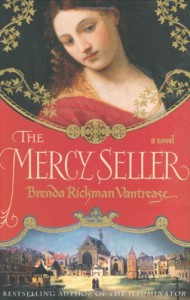 Unfortunately, far into this novel I realized it was a sequel to a book I'd been eyeing for a while, The Illuminator. I still enjoyed this book without having any idea of its prequel's plot It stand well on its own.
 This story focuses on the red haired Anna, (the next gen from the 1st book) a Lollard trying to make her way to England, seeking refuge from religious prosecution. We get an omnipresent view of other characters, but I was relieved that the strong willed and intelligent heroine didn't take everything over. While I like such a heroine, I've read 3 books in a row now with the same archetype; a change is nice. Gabriel, who is the subject of the witty title, I enjoyed more. His outdated thinking (for modern / intelligent readers) reflects his time, and his struggle to reconcile the good of his heart with the unease he has with his actions is very gratifying. Caught between loyalties, rights & wrongs, is hard for anybody, but so much more in those days when everything was so extreme. Vantrease certainly makes the in between points of history entertaining. The story focuses on the brave who fight for what they believe is a change for the better and the strong who wish to keep the status quo, then the people in the middle, like Gabriel, who struggle to find a place to fit in once the line of right and wrong are torn down and are up for reinterpretation. Then we have Henry V, who I was really sorry wasn't more apart of the story. His coping with the change of their time was interesting since he had so much less choice than all the others, despite all that he is a king. Last was Sir John, who was more showcased than analyzed as the others were. He was so distinct and constant that the whole book might have been a "glory hallelujah" to his Martyrdom. He felt the most real as a character but the least real as a flawed HUMAN; He is a hero from a fairytale, a shining ideal that you'll rarely, if ever, find in real life. The plot is not straight forward, there are conflicts everywhere and there's no real 'Main' conflict to resolve. It might have been Anna & Gabriel's relationship, there so many open threads as though the story could go on forever, but if the point was to elucidate the chaos and unsettlement of the time then Vantreage did so. For me, this is a story about where to find "mercy" and "grace" in your own personal revolution, when your world is falling apart and you have to not only survive the change but come out of it better in mind, body, and spirit.
Do Androids Dream of Electric Sheep?
 I have no idea how to go about reviewing this. Maybe I should point out that I am very much not a sci-fi reader. Reading this was my effort to rectify that. Maybe this wasn't the book to start with. Or maybe it was the best.
 All I can say is that the world was strange and beautiful and very much a world I would never want to live in. I didn't understand any of the relationships in the book, but by the end, I realized that maybe I wasn't meant to. It did make me think about a great many things, but often I felt like I was chasing my own thoughts in circles and most of my near insights came to nothing. With the ending I didn't know if I should be comforted or disappointed. Honestly I was a little bit of both.
I had less difficulty coming to grips with Thompson's Fear and Loathing in Las Vegas. I just find it strange that a drug-filled primarily hallucinogenic book with references made to decades well before my years, makes more sense to me than Do Androids Dream of Electric Sheep.
I may not have enjoyed it, per se, but I am glad that I read it.
Black Blade Blues
 There's alot of interesting things going on in this book, but I'm not sure all of it came together well.
I was a little blindsided by the f/f relationship, nothing in the blurb or cover suggested as such to me, which was a pleasant surprise. The author, despite being a man, writes the female perspective pretty convincingly. What wasn't pleasant, however, was just how much of the book centered on this relationship and the characters issues with sexuality, which adds up to about half the entire book. It was was all very well done, but I had expected an entertaining read, something "lite". This had much more substance than I was in the mood for. I really felt for Beau and while I did like the peek into a torn psyche, it became so heavy and central that I couldn't help thinking often, "ok, enough, on with the dragons and the end of the world." Then I got my wish and that's where the book kind of fell apart for me. The huge battle at the end was stupefying. There was a long garbled and physics bending fight in a helicopter that I couldn't wrap my head around. Then there was this last section that felt like nothing more than really bad fan-fiction based in Norse mythology. Gah, and it had, of all hateful things, one of those characters who is sitting on very vital and relevant information for no real reason other than that the author isnt ready to let you know yet. The wrapping up was good, but I really wish there was more focus on the Dragon foes and the world they lived in. Honestly, that was the story I had been expecting, and I'll be honest, the one I'd rather have read.
I want to see Beau more comfortable with herself and see how she and Katie develop, but nothing else impressed me enough to wanna pick up the next book. I didn't hate it but there was too much wrong for me to really enjoy it. The characters are great (except the villain), the ideas are interesting but they just don't come together well for me.
Context Free Quote:
Once a King always a King, but once a Knight is enough.
The Tower at Stony Wood: A Novel
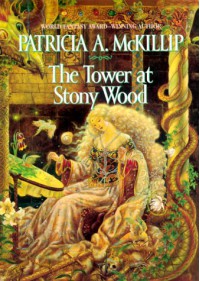 After having this book and it's gorgeous cover haunt my shelf and memory for years, I finally picked it up and read it all the way through. I won't lie: it was hard going for a while. Its beautiful and haunting but its also very difficult to understand without giving it your undivided attention. It forces you to spellbind yourself, because otherwise you can not appreciate it. There is much of it that is straightforward, but then the rest of it is layered in lyrical and abstract magic so that I often found myself wondering if I knew what I was reading/understanding, just like its hapless hero, Cyan Dag. I felt both helpless and awed at the language and even the power of the story. By the end of it, I felt like him, wanting to cry for no reason, so glad it was all over, but afraid of its ending.
 I think the first time I tried to read this I was too young; the abstractions were too vague for me to harness, and there is a bitterness and maturity to this story that would be lost on youth. Not to say that a child can't read it, but I really think this story would have more power over people who have left magic behind.
In the end, that is what the story is about, returning magic to those who have forgotten it, relearning that there is a power in the world that is so much bigger than ourselves and that we may never fully comprehend. When you're a child you understand in your innocence that you are ignorant and its only when you grow older that you forget that awe and wonder and you believe that you know everything, that the world is as limited as your experience of it.
The Tower of Stony Wood reminds you different.
The Merry Adventures of Robin Hood
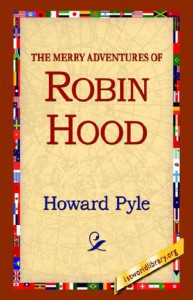 While reading this I kept thinking what a shame it was that I hadn't read this as a child because it's just the kind of story I would have loved as a girl. Truthfully, as an adult I still love it. The prologue itself tells you that if you're a sourpuss and like to take things too seriously, you'd best stay away. I was always a tenant of "the Land of Fancy" as Pyle calls it, so I was very happy to spend time in between the covers of his book. I found myself laughing and smiling throughout all the many stories. I will say that I did not always understand the jokes Robin and his men made, the language is archaic and it was not always easy reading but it was always enjoyable. Robin Hood was my favourite Disney movie as a child and the Kostner version is still a guilty pleasure of mine, but little did I know how different the actuall adventures from the book were. The only time seriousness comes about is at the end, in the Epilogue, which I loved despite that I cried the whole time I read it. The only thing more I could wish for from this book was to actually hear all the many songs sung in it's pages.